

Our SchoolSEND Department
Text
SEND Information Report:
Agreed by Governors 29th June 2025
SENDCO: Mrs. J. Buckley-Dibben
This page acts as King David High School’s Information report and explains in more detail how the SEND Policy is implemented at King David High School. This outlines how King David High School’s vision for the implementation the legislation and guidance within:
-
SEN Code of Practice 0-25 (2015)
-
Equality Act 2010
-
Part 3 of the Children and Families Act (2015)
-
The Special Educational Needs and Disability Regulations (2014)
We (the SEND team, the leadership team, teaching staff and the governors) aim to provide every possible opportunity for every child to develop their full potential. Children with Special Educational Needs must be valued as individuals and should be encouraged to integrate with their peers, both socially and academically. They should have access to the school curriculum. At all times, consideration will be given to maintaining and enhancing the self-esteem, self-advocacy and independence skills of children with Special Educational Needs.
Teachers are encouraged to respond to pupil’s diverse learning needs. Teachers take account of SEN requirements and make provision, where necessary and where possible, to support individuals or groups of children, enabling them to participate effectively in the curriculum activities, extra curricular and whole school activities. Such children may need additional or different help from that given to other children of the same age.
We support children in a manner that acknowledges their entitlement to share the same learning experiences that their peers enjoy. We want students with SEND to have the same opportunity to have a broad and balanced curriculum as their peers. We want all students in as many lessons for as long as possible. Wherever possible, we do not withdraw children from the classroom situation. There are times, though, when to maximise learning, we ask the children to work in small groups, or in a one-to-one situation outside the classroom
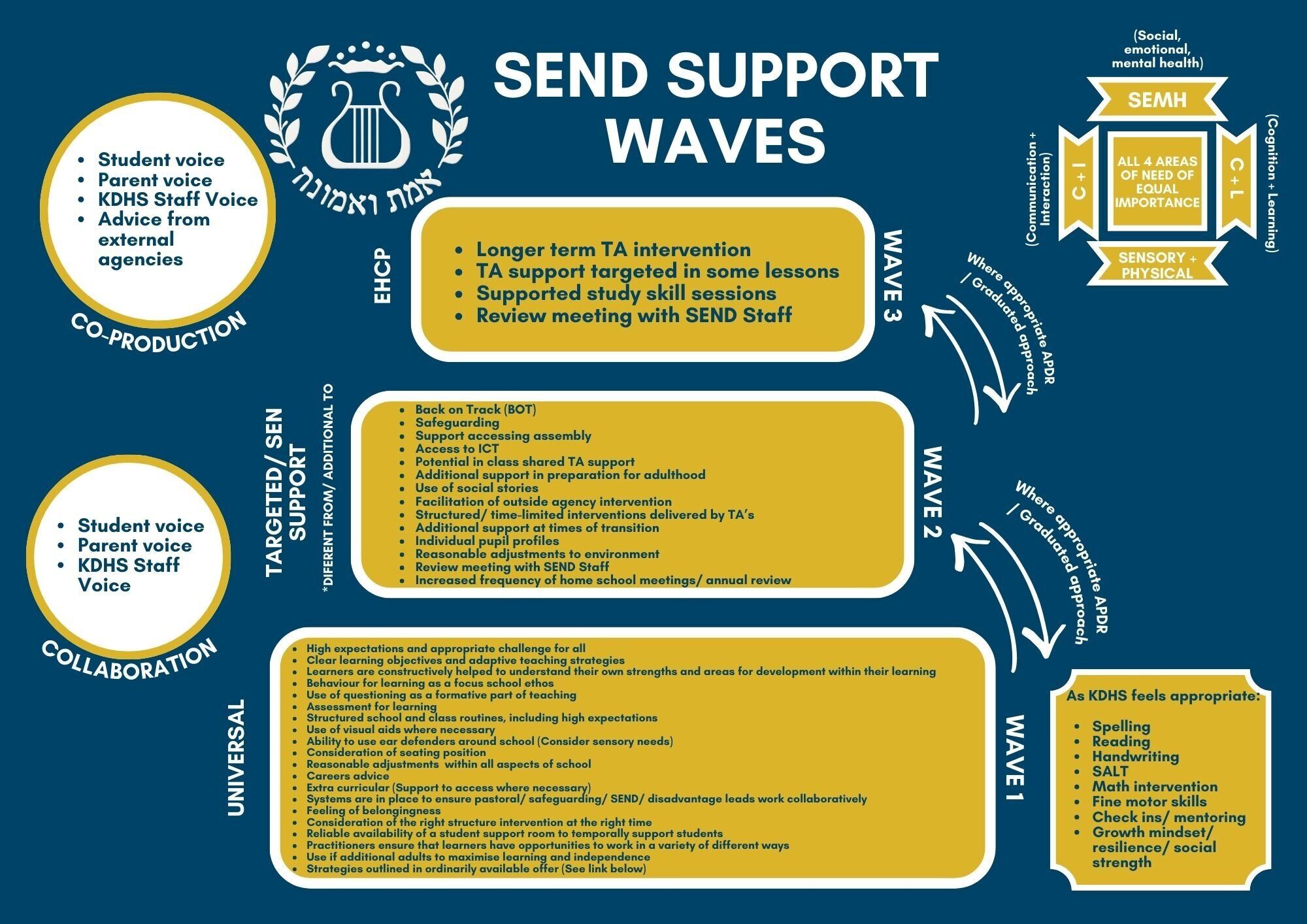
At King David High School we support students with a range of Special Educational Needs and Disabilities (SEND). We operate a needs led model, meaning that we will make reasonable adjustments for students based on need, not diagnosis alone. There are four areas of needs:
-
Communication and interaction, for example, Autism, speech and language difficulties.
-
Cognition and Learning, for example, dyslexia, dyspraxia, undiagnosed learning needs.
-
Social, Emotional and Mental Health Difficulties, for example, attention deficit and hyperactivity disorder (ADHD), anxiety.
-
Sensory and/or physical needs, for example, visual impairments, hearing impairments, processing difficulties, cerebral palsy.
Students’ SEN needs can be highlighted/identified in the following ways:
-
At transition, in discussion with primary school, external agencies and parents
-
During meetings between the students, school and parents at transition, admission and as needed. At King David High School, we firmly believe in the importance of co-production
-
By assessments on entry into the school
-
By assessments set by class teachers. The SENDCo or Assistant SENDCo attend data meetings for each year group
-
Through screening assessments
-
Through external agencies
-
Via school staff. In addition to pupil and parent voice, strong communication between SEND colleagues, pastoral colleagues and teaching colleagues is vital for the timely identification of need and subsequent implementation of appropriate support packages.
At King David High School we are passionate about SEND being a whole school responsibility.
Below is a visual which outlines how students with SEND can be supported following a graduated response and by a range of members of staff at King David High School.
Text
Glossary
|
Term |
Definition |
|
ADPR |
Four types of action are taken to put effective support in place(ASSESS, PLAN, DO and REVIEW). These actions form part of a cycle through which earlier decisions and actions are revisited, refined and revised with the growing understanding of the pupils’ needs. |
|
Coprodution |
The collaborative production of documentation and a support package. This might involve students, parents, school staff and external agencies |
|
EHCP |
Education Health and Care Plan is an official document created by the Local Education Authority (LEA). It instructs schools about the provision a student requires. Students with an EHCP will get an annual review meeting which will be submitted to the LEA. |
|
Graduated Response |
An approach advocated by the Code of Practice which advises support should be implemented in a gradual/stages approach and regularly reviewed in the APDR cycles. |
|
Ordinarily available offer |
This is a document which outlines what QFTs might be ordinarily available in an educational setting. An example of such offers can be found: GM OAIP Wigan |
|
Pupil Passport/Profile |
A one-page profile which summarises a students strengths/interests, areas of needs and advises on how to best support the pupil in the classroom. |
|
QFTs |
Quality First teaching Strategies are strategies that can be implemented by a class teacher. They do not require additional intervention from members of the SEND team. |
|
SALT |
Speech and Language Therapy |
|
SEN Support |
Students who are on SEN Support will be getting something “additional to and different from”. This might include a structured intervention, TA support or the input of an external agency. Students who are on SEN Support will get an annual review meeting |
|
Structured Interventions |
Structured interventions follow a specific program as advised by external professional or directed by the SENDCo. These will usually be time limited. |
|
Targeted |
More targeted support is received by a smaller group of students. Students at SEN Support will be getting targeted support |
|
Universal |
This is the offer that all students can expect to receive |
Meet the Team
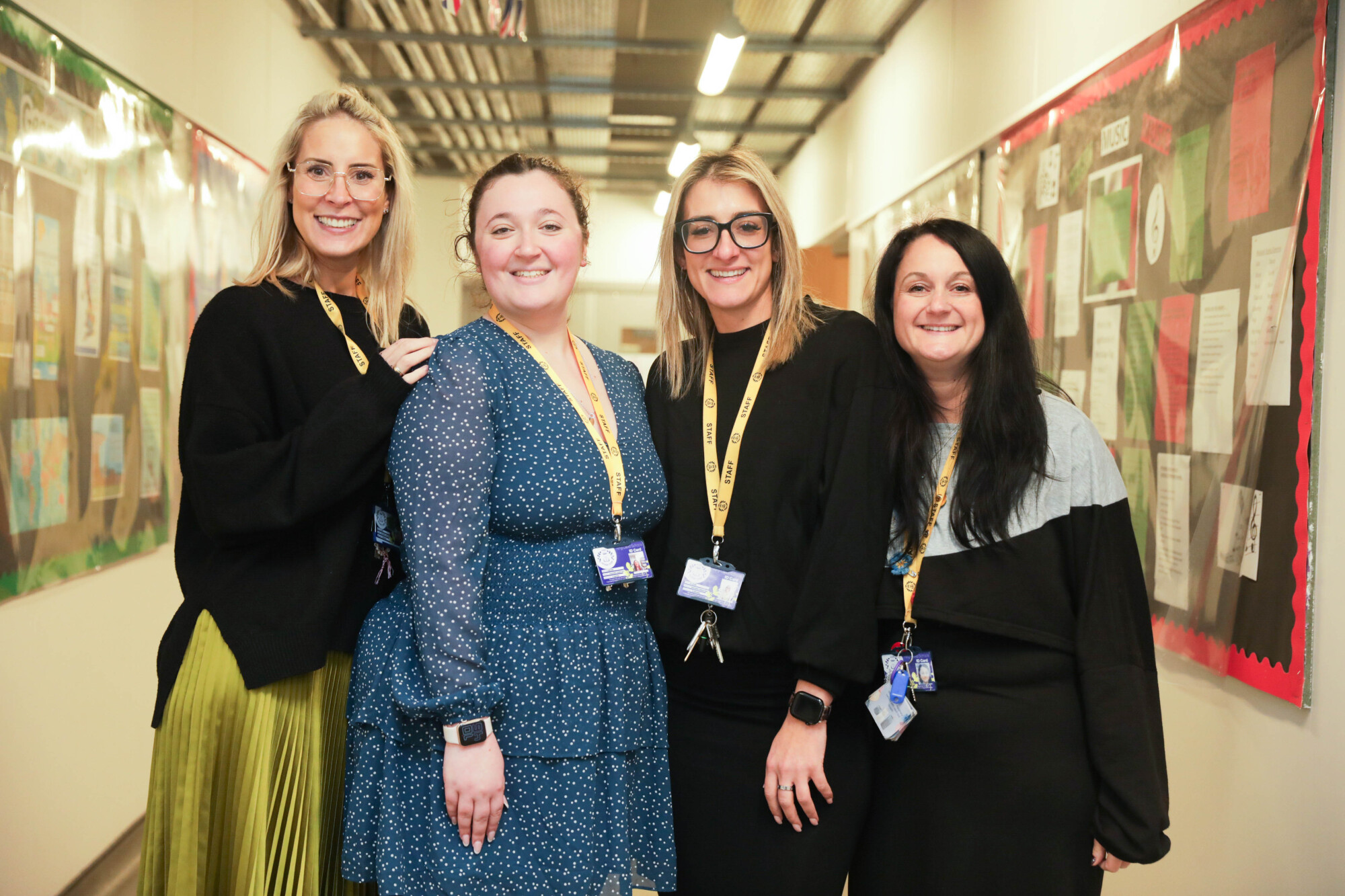
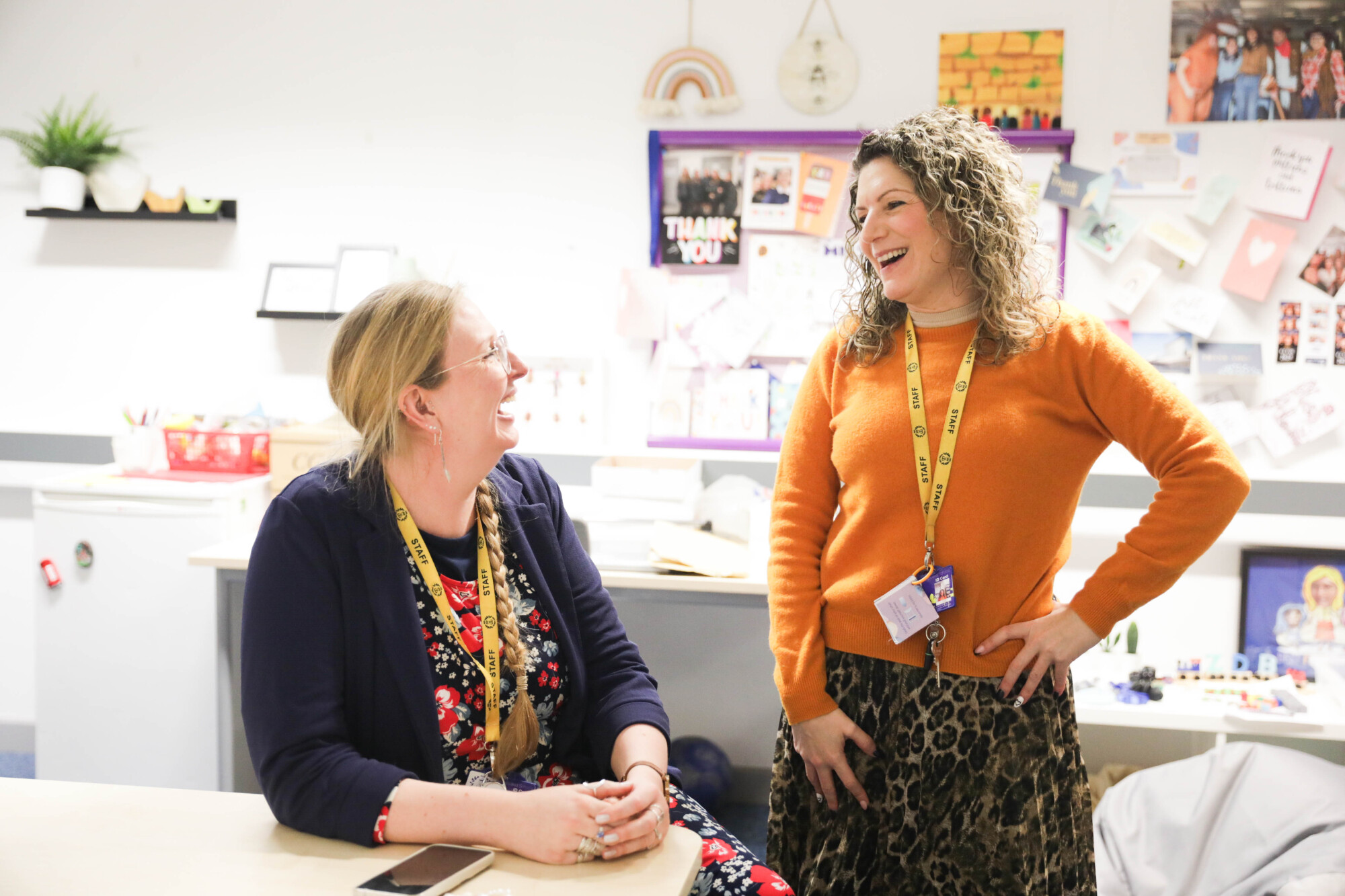
The SEND team is currently made up of the SENDCo, The Assistant SENDCO and Teaching Assistants
The SENDCo and Assistant SENDCo devise a training programme each year both for teaching staff and for the Teaching Assistants to ensure that they are equipped to be able to support students currently at King David High School.
Gallery
Text
|
SENDCo and Assistant Headteacher Mrs J Buckley-Dibben |
Assistant SENDCo Mrs Myers |
|
Email: j.buckley-dibben@kdhigh.co.uk Mrs Buckley-Dibben has worked in number of roles in education. These include, Learning Support Assistant, Teacher, Curriculum Co-ordinator for Transition Pathway, Specialist Teacher, Assistant SENDCo and SENDCo. Mrs Buckley-Dibben has a PGCE in English with SEN, A Masters in sociology with a focus on education and additional needs, Level 7 post graduate diploma in Specific Learning Difficulties and completed the |
Email: m.myers@kdhigh.co.uk Mrs Myers began her career in education as a primary school teacher of KS2. After a move back to Manchester she developed her interest in working with students with SEND by becoming a Teaching Assistant. After 5 years at King David High School she started working as assistant SENDCo. Mrs Myers has an English degree and a PGCE in Primary Education. She is currently undertaking her NPQSENDCO qualification. |
Other useful information
Parents and guardians might find the following services helpful:
NSPCC - Supporting Children with Anger Management: How parents can help.
SEND Local offers:
The local offer provides information about all the services and support that is available in an area for pupils with SEND and their parents and guardians.
Bury - Bury SEND Local Offer - Bury Council
Manchester - Local Offer SEND Information Hub | Help & Support Manchester
Trafford - Trafford Directory | Trafford SEND Local Offer
Stockport - SEND Local Offer - Stockport Council
Rochdale - SEND information and advice | Rochdale Borough Council
Salford - Local Offer: For children and young people with SEN or disabilities•Salford City Council